For specifiers
Surfaces by backing and where each one goes, the documents a tender asks for, and installed work to look at. Start with the six surfaces, then the application closest to your project.

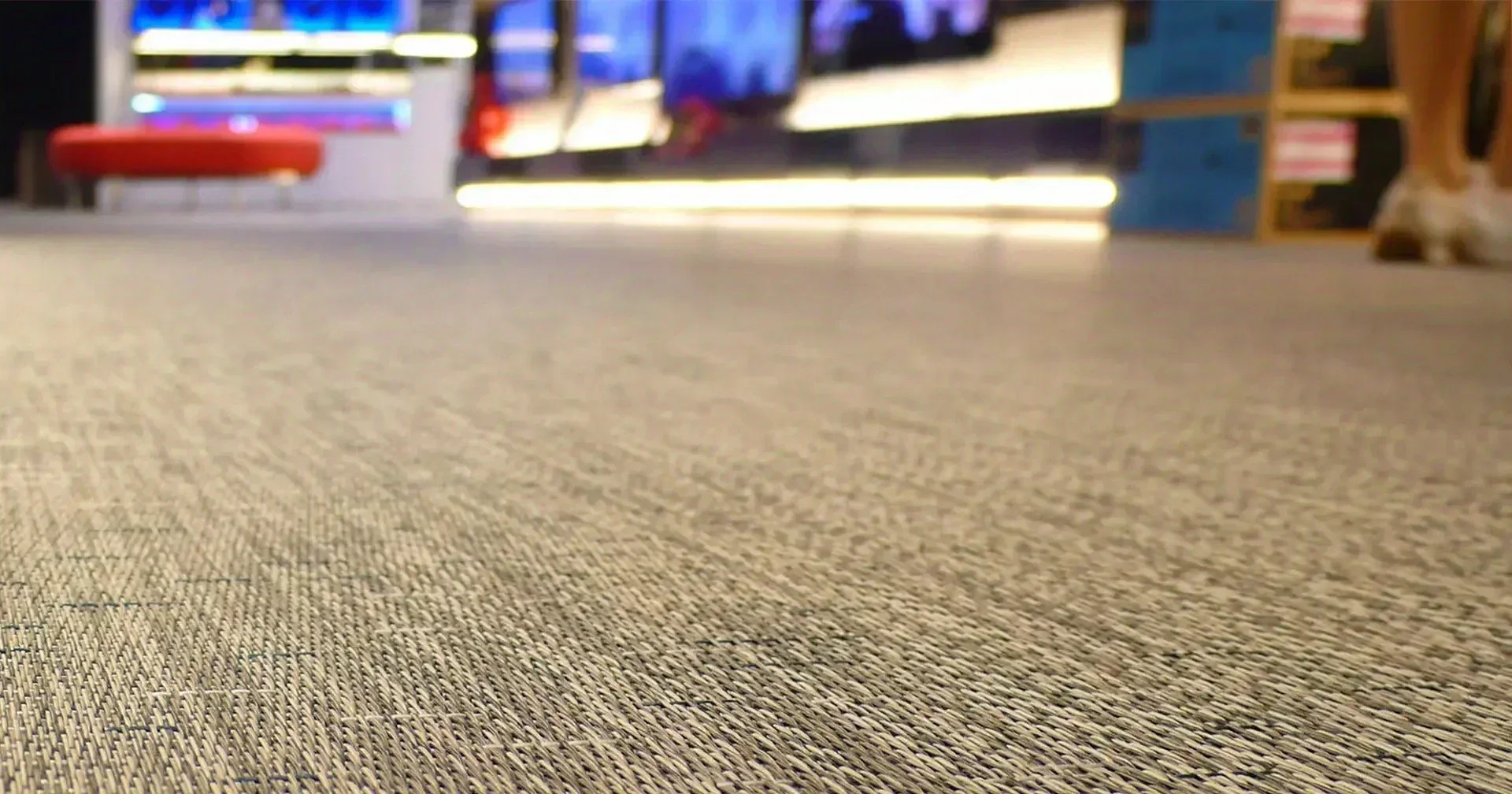
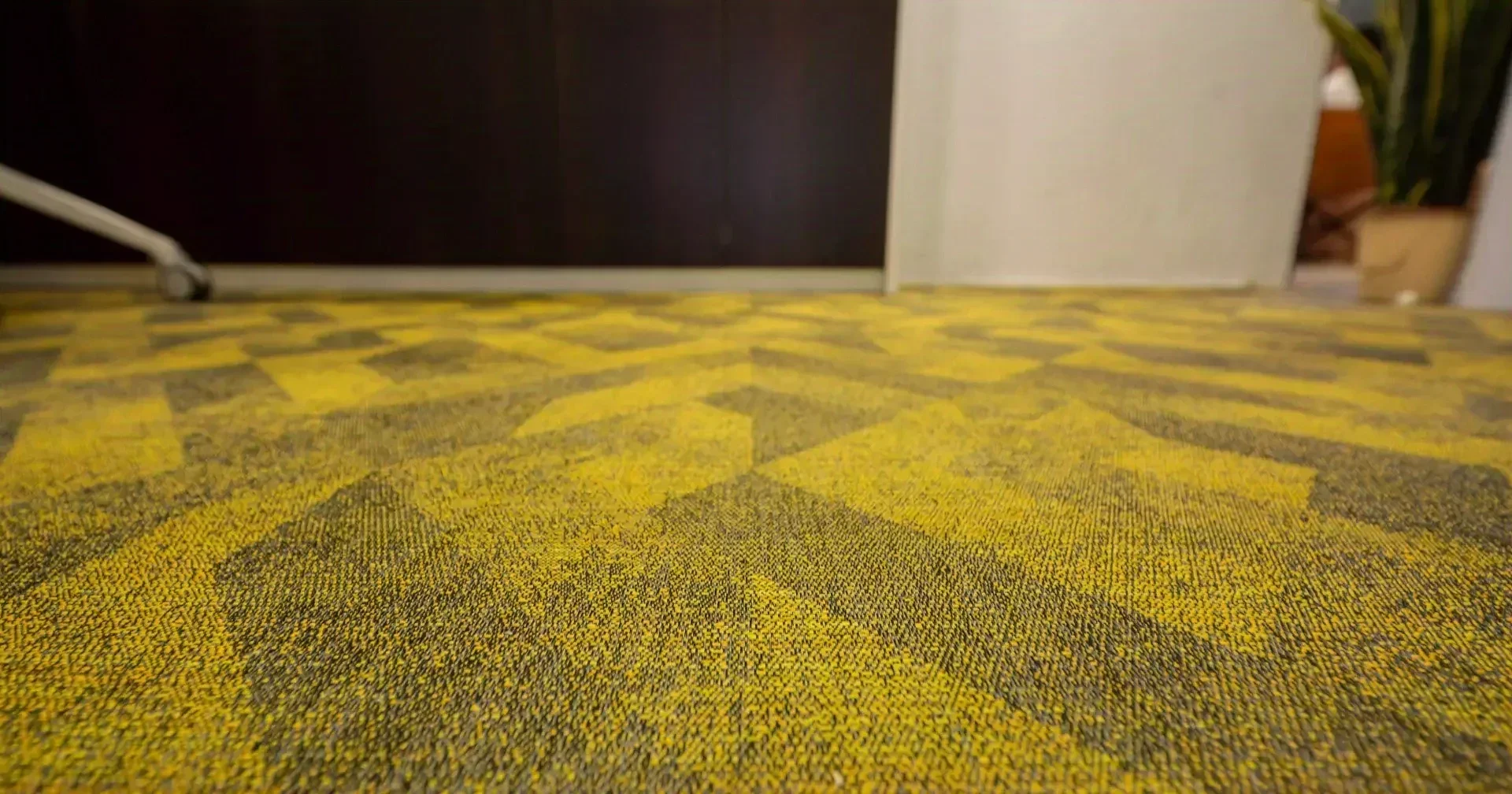
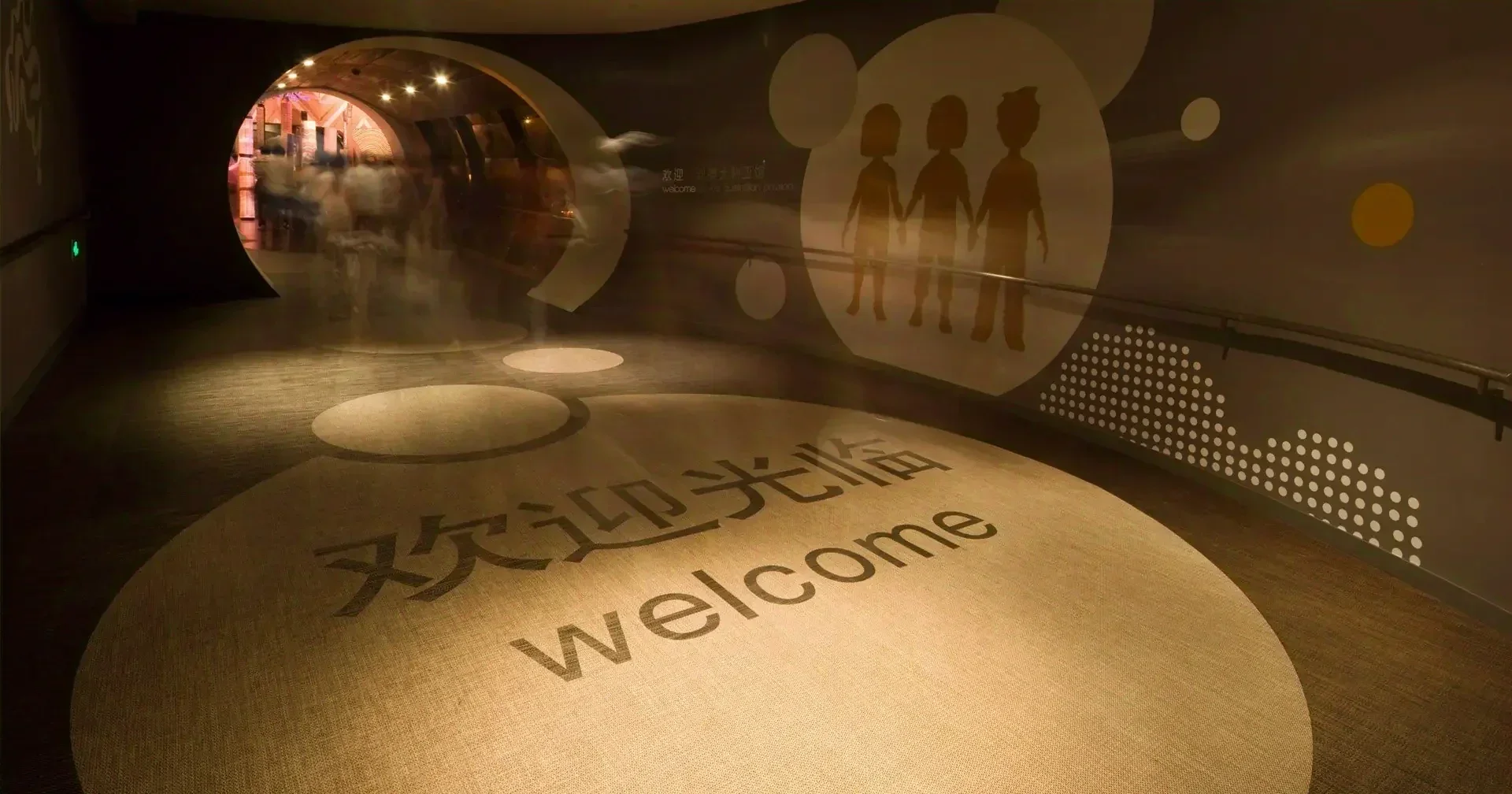
We make woven vinyl with the look and feel of a natural fibre, and finish it ourselves for floors, walls and furniture. Yarn, weaving, coating, backing, finishing and testing all happen at our own production base in Zhejiang, China.
Sample book patterns are held in stock and ship in as little as 2–3 weeks.
Specifying a project, or stocking the range? The two routes ask different questions, so they are answered separately.
Surfaces by backing and where each one goes, the documents a tender asks for, and installed work to look at. Start with the six surfaces, then the application closest to your project.
Installation, seaming, adhesive and maintenance: the method statements and the numbers an installer works to on site.
Trade terms in one table: minimums, lead times, container loading, FOB Shanghai and private label. Written for a buyer building a range, not for a single project.
Woven vinyl starts as vinyl-coated yarn. The yarn is woven into a textile on a loom, in the way furnishing fabric is woven, then coated, finished and bonded to a backing. The pattern comes from the weave and from two-tone yarn rather than from a printed film, so the surface keeps a textile grain and the colour runs through the fibre. The face is 1.0 mm of woven vinyl on a core of high-tenacity polyester as standard, or fibreglass where a wider seamless run or more dimensional stability is needed. Backings change with the product line: 3.0 mm PVC foam for rolled flooring, 2.2 to 2.5 mm vinyl with fibreglass and acoustic felt for tiles, and PET non-woven for wallcovering. The result behaves like a resilient floor and reads like a woven textile. Cleaning is vinyl work, a vacuum or a damp mop, with no waxing. Specification is textile work: colour, weave and reference numbers.
Six lines, one material. The woven face is the same across all of them, so what changes is the backing and the format, and those two decide where the surface can go. Rolled flooring and floormats take a 3.0 mm PVC foam backing and are bonded and cold-welded on site. Acoustic modular carpet is die-cut into tiles from a 2.2 to 2.5 mm vinyl backing with fibreglass and a felt layer, so a damaged piece lifts out and goes back in the same afternoon. Wallcovering hangs on PET non-woven with a 1.0 mm woven face. Upholstery is the bare fabric, optionally on a 1 mm vinyl cushion. The customers are distributors, architects, interior designers and flooring contractors, and the specification route is the same whichever line they start from: a data sheet, a fire class and a fastness report.

Woven vinyl wall to wall flooring with the look and texture of a textile carpet and the easy care of vinyl, laid wall to wall over the subfloor with the seams cold-welded. The 3.0 mm PVC foam backing is part of the 4 mm nominal build; the construction tested at 4.1 mm achieved ΔLw 21 dB to BS EN ISO 10140-3 (SATRA report 4343-3975)

Woven vinyl acoustic tiles, die-cut as squares, planks, or customer shapes. A 2.2–2.5 mm vinyl backing with fibreglass and acoustic felt brings the tile to 3.20–3.50 mm, and takes the edge off impact noise. Face yarn comes on a high-tenacity polyester core as standard; specify a fibreglass core to keep loose fibre off the cut edge and the surface.

Woven vinyl wallcovering. A woven textile face on a vinyl build: wipe it clean and it keeps its colour in corridors and guest rooms. It shrugs off scuffs and scrubbing, does not soak up moisture, and hangs without marking the face. No mould, no seam lifting or curling, no yellowing.

Woven vinyl upholstery in vinyl-coated PET yarn, for contract and residential seating: office chairs, banquettes, benches and headboards. It can be sewn or HF-welded, and welding gives a flat seam with no stitch line. Tensile, tearing, burst and Martindale results are on the data sheet.

Woven vinyl wall upholstery for panels, headboards and feature walls. Same face as the furniture line, on a PET non-woven backing where it hangs, or a 1 mm PVC foam backing where the wall takes contact. It wipes clean where a painted wall would show every mark.

texlymat® floormats, runners and rugs are finished pieces in woven vinyl with a high-tenacity polyester core: cut and finished with a bound edge or self binding. UV-stabilised and hose-cleanable, so they can stay outside on patios and balconies and come back inside for entrances, hallways, kitchens and bars. Made to order as mats, runners and area rugs.
Eighteen collections are published, from bamboo and basket weaves to herringbone, slub and stripe. A collection is a weave, not a product, which is why most of them run across several lines: the same weave can be specified as wall to wall flooring, as acoustic tiles, as wallcovering or as upholstery, and the room reads as one surface. Each collection page lists its colourways with reference numbers, because a reference is what a quote and an order are built on. Colour is solution-dyed into the yarn rather than printed, so the weave carries a two-tone grain and each production run has its own quiet variation. Twelve of the collections are stock qualities, which means no minimum order and shipping in 2 to 3 weeks.

The newest texlyweave® patterns, gathered into the 2026 collection.

BAMBOO is a fine vertical weave that echoes the look of natural bamboo, a quiet, linear surface with a soft hand.

BARCODE plays with bar widths, broad colour blocks interrupted by thin lines, closer to a graphic print than a weave.

HERRINGBONE takes a classic textile parquet and weaves it in fine vinyl yarn, so the surface reads traditional while it behaves like a technical flooring.

TRUCCO breaks a broad stripe into fragments: bands of different widths and textures running together in vertical stripes.

GRID is built on a crisp square structure, an architectural weave that holds a straight line across a floor or a wall.

STRIPE is a pinstripe in woven vinyl yarn: even lines that run with the roll and give a room direction.

MONO is a single-tone weave, one colour, two tones of yarn, and nothing else.
A contract floor is usually chosen from those three. What settles the question is the list of things that will fail first in the building, and how each material handles that failure.
| Question | Woven vinyl | LVT | Carpet tile |
|---|---|---|---|
| Where the look comes from | Weave and two-tone yarn, no printed film | Printed decorative film | Pile and yarn colour |
| Format | Roll 200 cm (±1%), or tiles 50×50 and 100×100 cm | Plank or tile | Tile |
| Impact noise | ΔLw 21 dB on the construction tested (4.1 mm, BS EN ISO 10140-3, SATRA report 4343-3975) | Depends on backing and underlay | Depends on backing |
| Airborne absorption | αw 0.05, not categorised (EN ISO 354) | Generally low — ask the manufacturer for the figure | Generally higher — ask the manufacturer for the figure |
| Water on the surface | Vinyl, joints closed when cold-welded | Vinyl | Needs attention quickly |
| Replacing one damaged area | Lift a tile, or cut out and re-weld a roll | Lift a tile | Lift a tile |
| Documents to ask for | CE to EN 14041, DoP, EN 13501-1, REACH, fastness reports | Same set | Same set |
A starting point, not a verdict. Every row has an exception, and the exception is usually the detail that decides the job. Read the full comparison →
Woven vinyl figures are measured and reported (SATRA 4343-3975; BS EN ISO 10140-3, 4.1 mm build as tested). LVT and carpet tile figures are general comparisons, not measurements made here — ask each manufacturer for the data sheet.
A surface that looks like textile and cleans like vinyl, for hospitality, corporate, retail, healthcare, education, residential and transport interiors. The examples below are real jobs — a school in Malaysia, a hospital in Korea, a gym in Kuala Lumpur. Locations only: clients are not named, and the photographs carry no client branding.

Guest rooms, corridors, lobbies and restaurants — conference and banquet floors, Hangzhou.

Open floors, meeting rooms and reception areas — a corporate library, Korea.

High-traffic surfaces that clean quickly — a shoe store, Taiwan.

Wipe-clean surfaces for clinics and hospitals — hospital waiting areas, Korea.

Floors and walls that stand up to daily use — an international school, Malaysia.

Living spaces, plus texlymat® runners outdoors — a residence, Hangzhou.
A specification survives on documents, not on adjectives. Four things decide whether a woven vinyl surface can be written into a project with confidence: original design rather than a bought-in pattern, stock held so a small order can ship, colour that is dyed through the fibre instead of printed on top, and a performance file that answers the fire, acoustic and fastness clauses in the spec. The four points below are what we can evidence, and each one has a report or a document behind it that can be sent to a client.
Every figure we quote comes with the report behind it. Flooring carries CE marking to EN 14041 (certificate 156) and wallcovering to EN 15102 (certificate 157). Reaction to fire is classified to EN 13501-1: Bfl-s1, d0 for the acoustic tiles and Cfl-s1, d0 for rolled flooring. Impact noise was measured at ΔLw 21 dB to BS EN ISO 10140-3 on the construction tested (SATRA report 4343-3975), while airborne absorption measures αw 0.05, which is not categorised. Colour fastness holds Grade 4 to 4.5 after 1,000 hours of UVA ageing, and castor chair testing rates r = 5 for continuous use. REACH, RoHS, AZO and phthalate screening sit behind all of it.
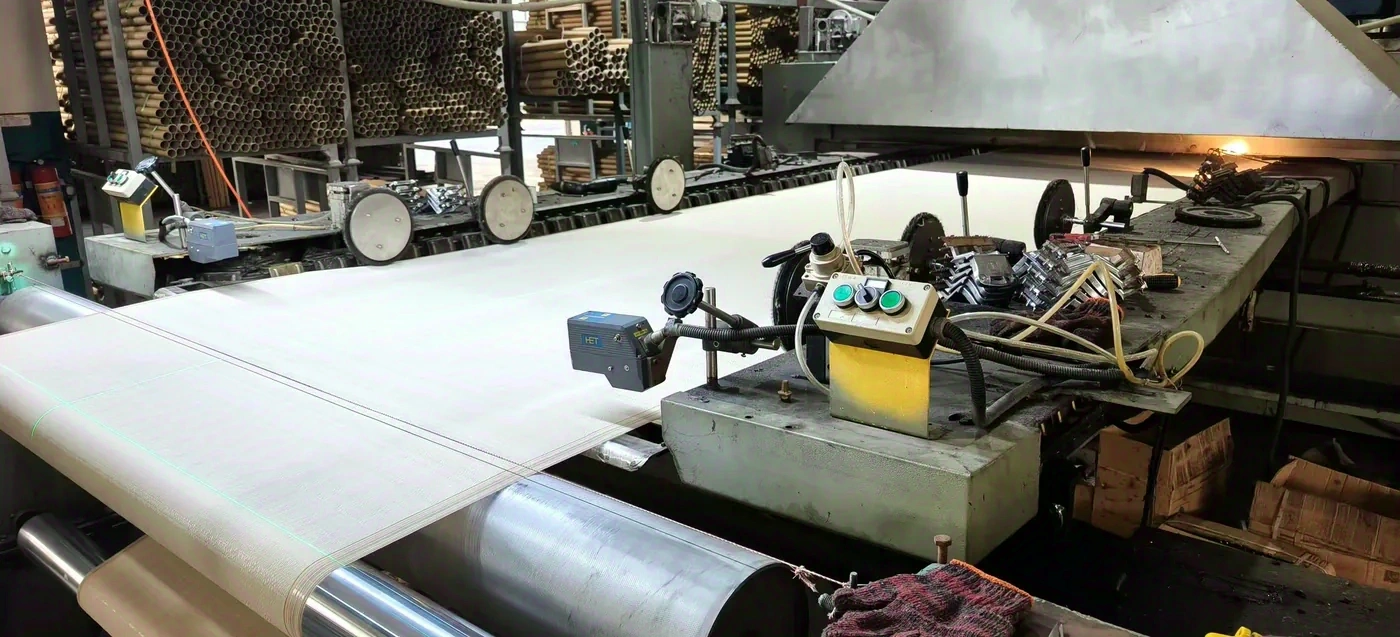
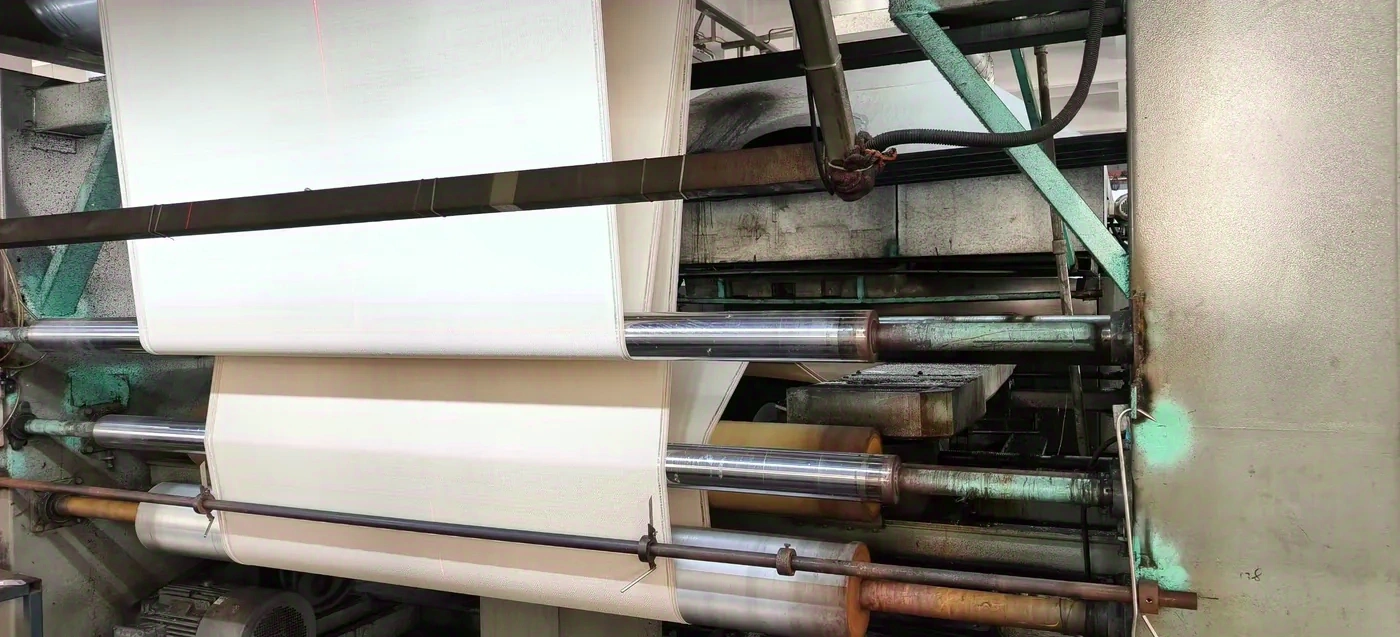
The office is in Hangzhou. The material is woven and laminated at our own production base in Tongxiang, about an hour west of the office in Zhejiang, China: 6,000 m² of production floor, fifty weaving looms, two laminating lines and a team of fifty, with capacity of around 20,000 m² a month. Wall to wall flooring, mats, runners and wallcovering come off the same plant, so a mixed order is one production schedule rather than several.

Woven vinyl web on the line.
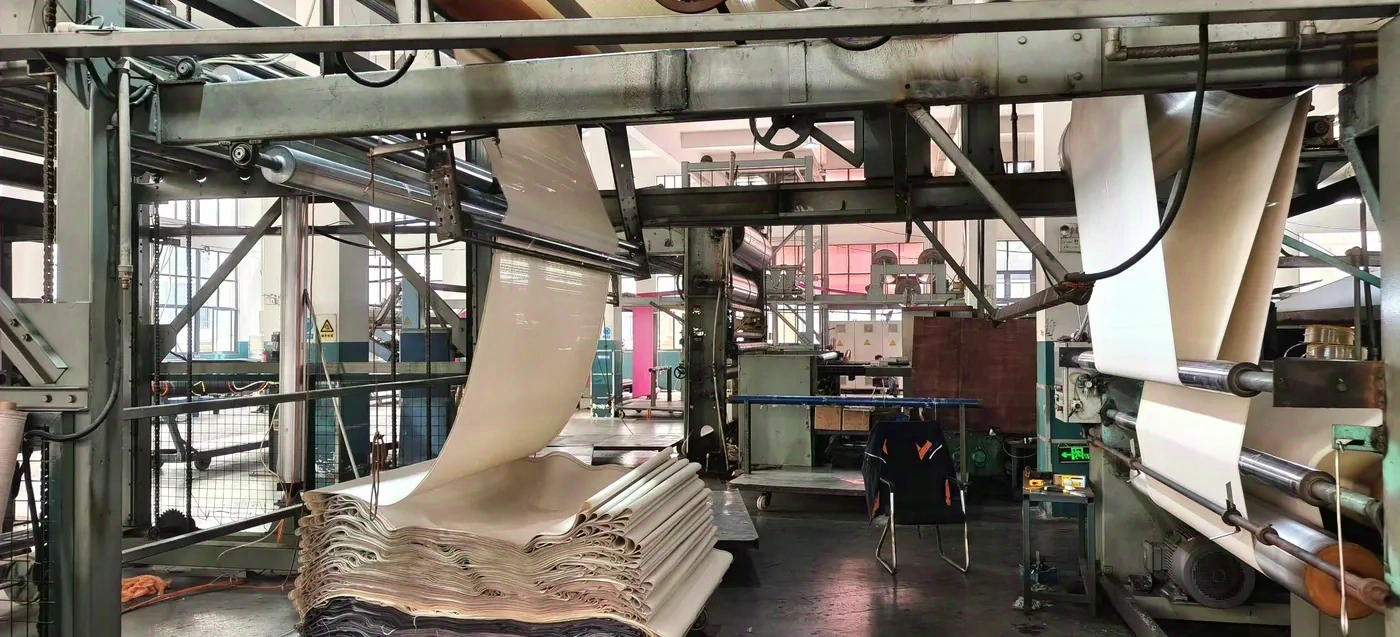
Where the woven web becomes a finished roll.
Rolls move by overhead hoist.
Rolls ready for cutting and packing.
The five that come up first in an enquiry. See all 32 questions →
Stock lines carry no minimum order quantity. Made-to-order widths and colours run 4 to 6 weeks; a design supplied by the customer starts at 1,000 m² per colour, and the exact minimum is confirmed with the quotation.
Sample books and A4 swatches are free of charge to qualified distributors and specifiers, with the courier at your cost (freight collect). Tell us the collections you are working with and we will send the right book.
Stock items can ship in as little as 2 to 3 weeks. Custom production takes 4 to 6 weeks after the samples are approved, and sampling itself takes 20 to 30 days.
Products are tested to BS EN ISO 105-B02 and BS EN ISO 105-B04 for colour fastness, and carry CE marking to EN 14041 (certificate No. 156) for flooring and EN 15102 (No. 157) for wallcovering. Fire classification to BS EN 13501-1 and impact sound reduction to BS EN ISO 10140-3 are stated in the declarations of performance, and the full report set is on the resources page.
Yes. Custom designs, colours and widths are developed in-house. Sampling takes 20 to 30 days and production starts at 1,000 m² per colour for most collections. Send the reference or the drawing and we will come back on what is achievable.
Selection guides: woven vinyl flooring, flooring for hotels, flooring for schools, gyms and studios, walls and furniture. All guides →